
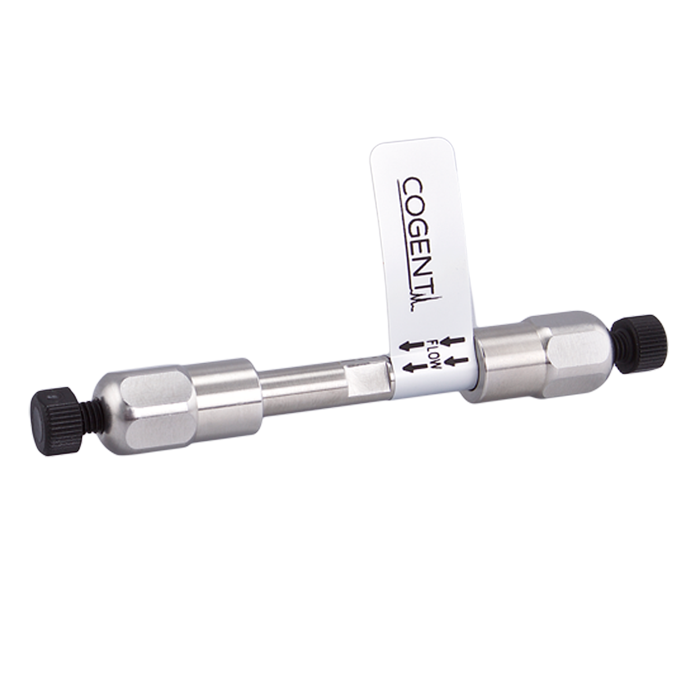
HPLC Column, RP PFP, 3um, 2.1mm ID x 50mm Length, 100A. Cogent Brand. 1 EA.
Additional Information:
The 68322‑05P‑2 Cogent RP PFP™ HPLC Column is designed for enhanced selectivity of halogenated, aromatic, and polar compounds, delivering improved resolution where traditional C18 phases may not fully resolve analytes.
This stationary phase utilizes a pentafluorophenyl (PFP, “F5”) ligand bonded via a four‑carbon linker to high‑purity silica with full double end‑capping, providing multiple interaction mechanisms including π‑π interactions, dipole interactions, and hydrogen bonding. These mechanisms allow for greater selectivity control and improved separation of structurally similar compounds.
The 100 Å pore size provides broad applicability across small to moderately sized molecules, making it a versatile choice for analytical and LC‑MS workflows.
50 mm Length – Fast Screening & Method Development
The 50 mm length is optimized for rapid separations and method scouting, enabling efficient evaluation of selectivity.
Short run times for high throughput
Efficient screening of retention behavior
Reduced solvent consumption
✅ Use when fast method development and selectivity evaluation are priorities
Flow Rate & System Requirements (2.1 mm ID, 3 µm)
⚠️ Requires low‑flow HPLC or LC‑MS system capability
Typical flow rate range: ~0.2–0.4 mL/min
Optimal starting range: ~0.25–0.35 mL/min
Higher backpressure vs 5 µm columns
Compatible with low‑volume LC‑MS detectors
✅ Sample preparation requirement: filter samples using a 0.2 µm syringe filter prior to injection
Why Choose PFP (F5) for Selective Separations
Enhanced Retention for Halogenated Compounds
Strong interaction with fluorinated and halogenated analytes
Improved selectivity vs C18
Multiple Interaction Mechanisms
π‑π interactions for aromatic compounds
Dipole and hydrogen bonding interactions
Greater flexibility in method development
Balanced Selectivity (100 Å Pore)
Suitable for a wide range of analytes
Supports both small and moderately sized molecules
Cogent RP PFP™ Advantages
Fully End‑Capped Surface
Minimizes silanol activity
Improves peak symmetry for polar analytes
High Efficiency (3 µm Particles)
More efficient than 5 µm columns
Sharper peaks and improved resolution
High Purity Silica
Consistent performance
Reliable reproducibility across analyses
Typical Applications
Halogenated compound analysis
Aromatic compound separations
Pharmaceutical analytical workflows
LC‑MS method development
USP L43 method applications
Important Usage Notes
Packed and shipped in reversed‑phase solvents
Designed for low‑flow LC‑MS and analytical HPLC systems (2.1 mm ID)
Higher backpressure than larger particle columns
Use 0.2 µm filtration to maintain column performance